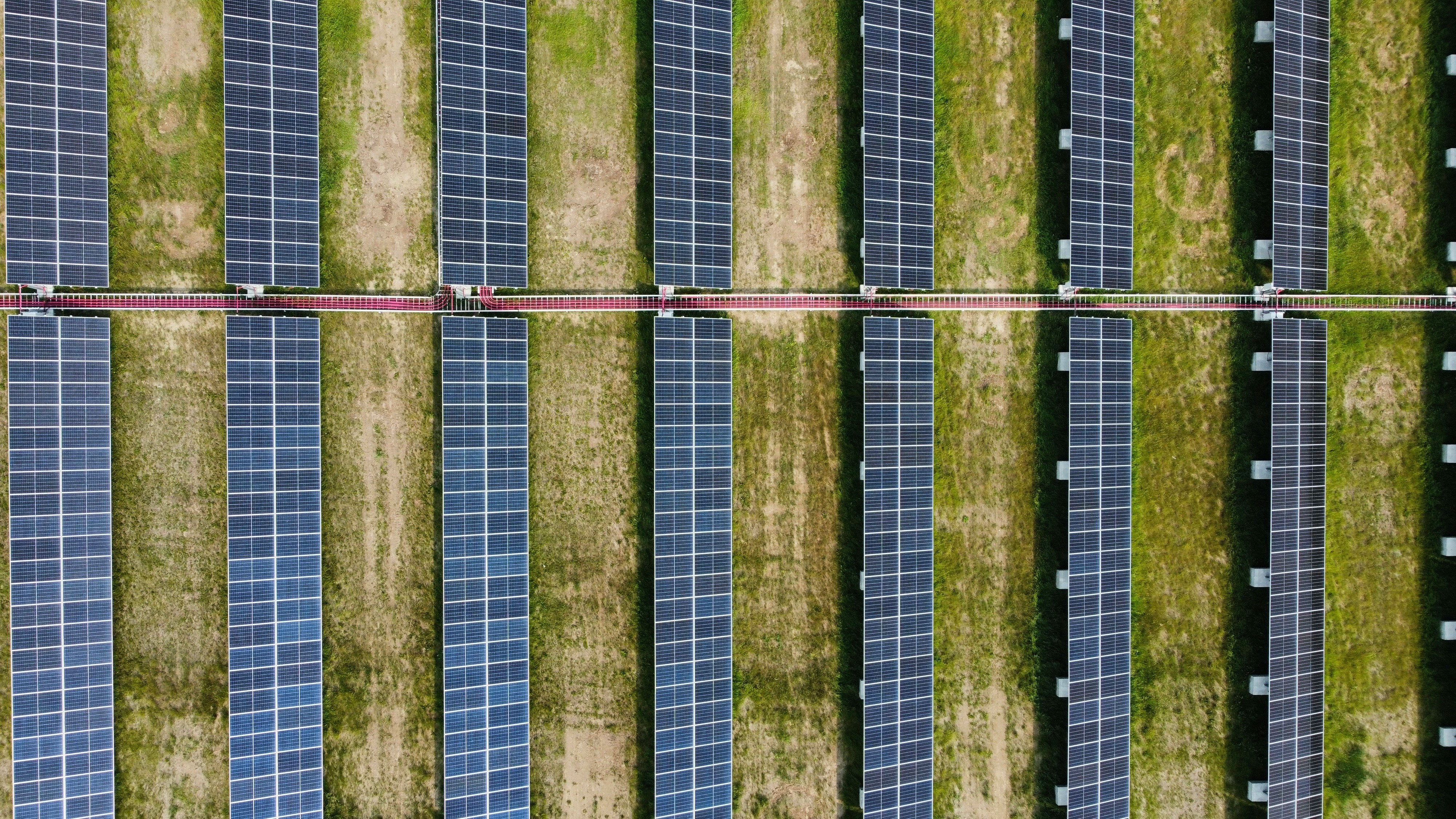
Yes — community solar is legit. In Maryland it is a real program overseen by the Public Service Commission. You subscribe to a share of a solar farm in your utility territory, credits land on your electric bill, and nothing gets installed on your roof.
What is not automatically legit is every salesperson at your door, every Facebook ad, or every urgent text that says you have to “lock in” tonight. The program is real. Some marketing is pushy, confusing, or worse. Verify the program, the contract, and the company — do not trust a pitch under pressure.
If you are in BGE, Pepco, Delmarva Power, or Potomac Edison territory and wondering about a “Community Solar Adjustment” line or a door knock, use the checklists below.
Skeptical is fine. Verify with your zip — see a real match before you sign anything →
What makes community solar “real”
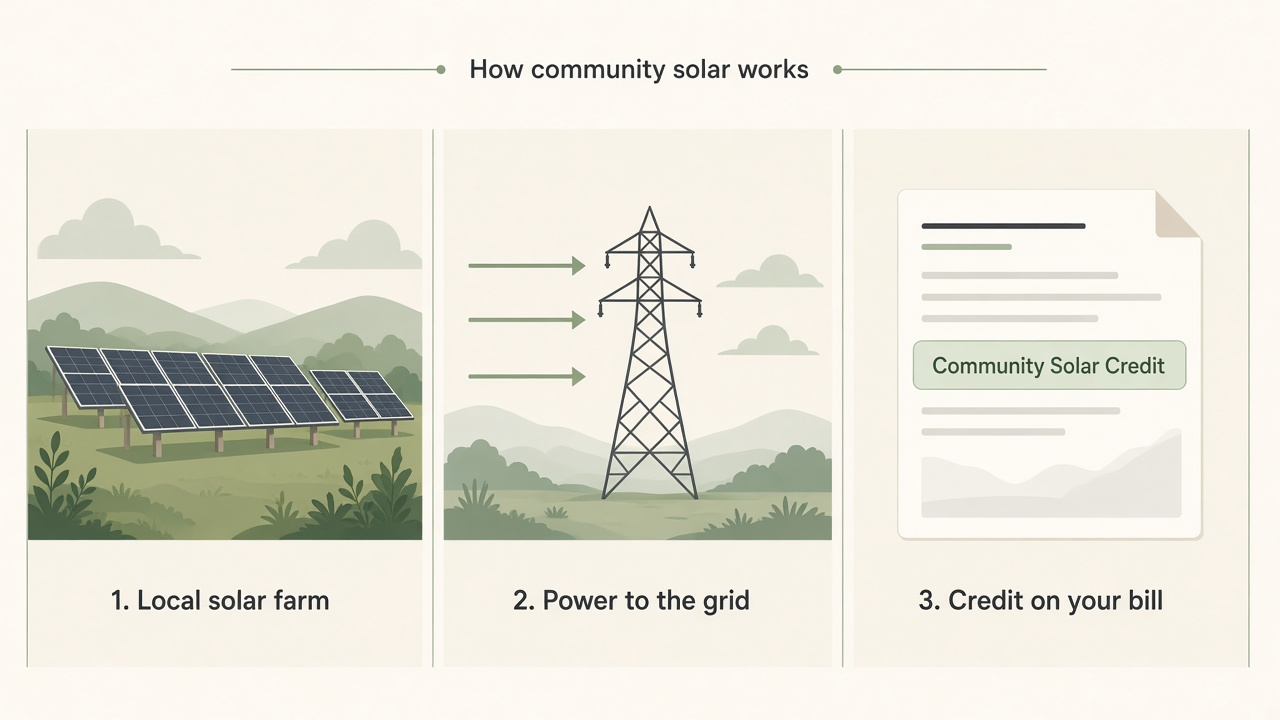
Community solar is not rooftop panels and it is not a retail electricity switch. In Maryland it works like this:
- A shared solar farm in your utility’s service territory generates power for the grid.
- You subscribe to a portion of that farm’s output.
- Your utility applies a bill credit for your share.
- You keep the same utility, the same meter, and the same outage response.
The farm is shared by two or more customers in the same utility territory. Renters can join if the electric account is in their name — no roof or equipment at your place.
Maryland’s program started as a pilot in 2015 (HB 1087 / SB 398; COMAR 20.62). The pilot ended December 31, 2024. As of June 30, 2024, the PSC reported 139 projects and about 204 MW of operating capacity. House Bill 908 (2023) made the program permanent; permanent regulations were published February 4, 2025. Source: the Maryland PSC community solar page.
Two roles you will hear about (PSC definitions, paraphrased):
- A subscriber organization owns or operates the community solar project, or is the collective of its subscribers.
- A subscription coordinator markets community solar or handles enrollment and admin under its own brand — connecting subscribers to projects without owning the farm.
Consumer protections sit in COMAR 20.62.05. Unfair, false, or misleading marketing is banned. Door-to-door agents need a background check and training. You should get a contract and a Contract Summary (disclosure form) before you sign. The PSC’s FAQ puts it plainly: read your contract. The PSC also states it does not regulate community solar rates — so nobody should claim “the Commission approved this exact discount.”
For the statewide picture, see community solar in Maryland. Utility hubs: BGE, Pepco, Delmarva, Potomac Edison. Basics also live on /learn.
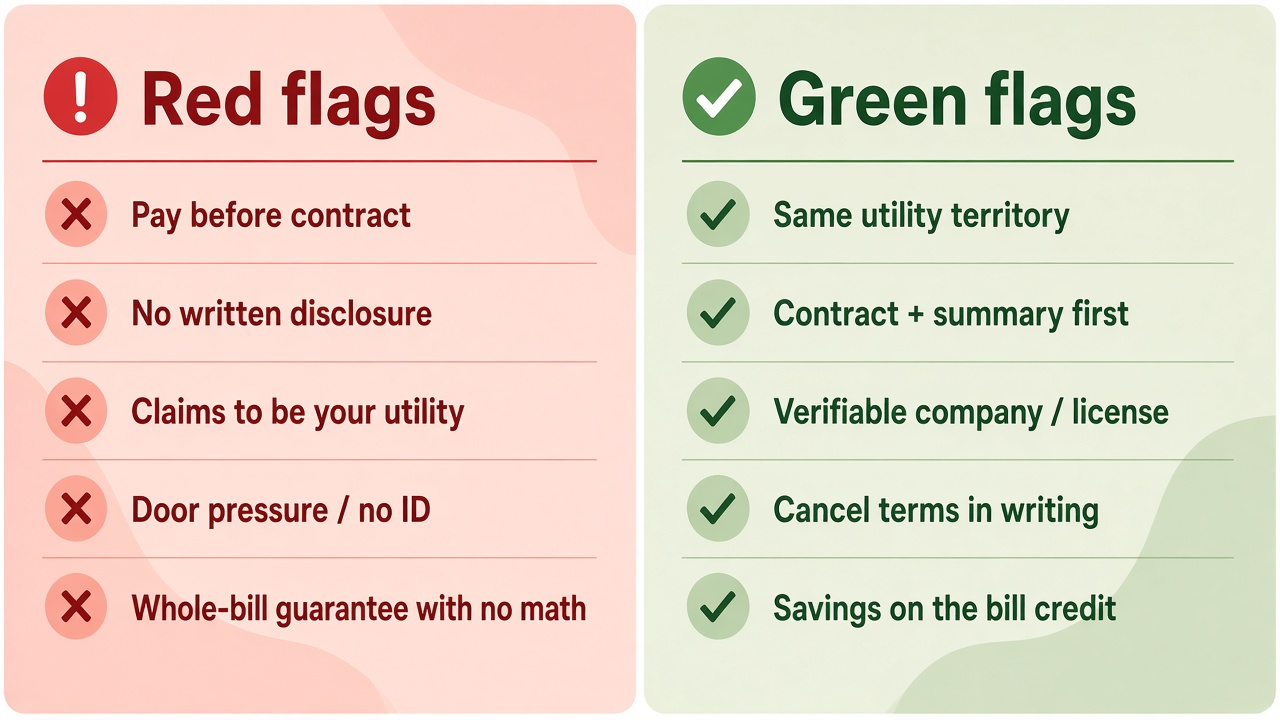
Red flags checklist
Slow down or walk away if you see these:
- Payment or a credit card “to reserve” before you have reviewed a written contract on a path that should be $0 upfront.
- No written contract or Contract Summary — “we’ll email it later” after you sign is not good enough.
- They claim to be your utility when they are not. Community solar companies are not BGE, Pepco, Delmarva Power, or Potomac Edison.
- Door-to-door pressure with no ID, no company name you can look up, or a story that you lose eligibility if you do not decide tonight.
- Guaranteed “whole bill” discounts with no credit math. Legitimate offers discount the credited solar portion under a written agreement — they do not magically slash every line forever.
- Requests for Social Security number, bank login, or a check just to “qualify.” Confirm what enrollment actually needs before you hand anything over.
- Confusion with third-party electricity suppliers. Community solar adds credits on your utility bill. It is not the same product as switching your energy supplier.
Pushy tactics can be abusive without every marketer being a criminal. Criticize the pitch, not brands you have not researched.
Green flags checklist
Signs of a real Maryland-style offer:
- Utility-territory match. The farm must serve the same utility territory as your account.
- Contract + Contract Summary before signing. You can read both at your own pace.
- Company identity you can verify — subscriber organization or subscription coordinator name, contact info, and (when relevant) Maryland PSC licensing.
- Cancel and move terms in writing. Cancel and move rules live in the written subscriber agreement — read them before you sign. Do not trust a verbal “cancel anytime” promise with no paperwork.
- Savings explained as a discount on the bill credit, not as a round-number guarantee for your entire bill forever.
- No surprise equipment. Nothing installed at your home.
- Clear complaint path — company contacts and Maryland PSC Consumer Affairs.
If a salesperson will not share a contract, walk away. Prefer a calm check? Verify with your zip — see a real match before you sign anything →
“Community Solar Adjustment” on my BGE bill — legit or scam?
A line labeled something like Community Solar Adjustment (wording varies) can appear on a BGE bill when you have an active community solar subscription. It often reflects credits and related subscription activity. That line alone does not prove fraud — and it does not prove everything is fine either.
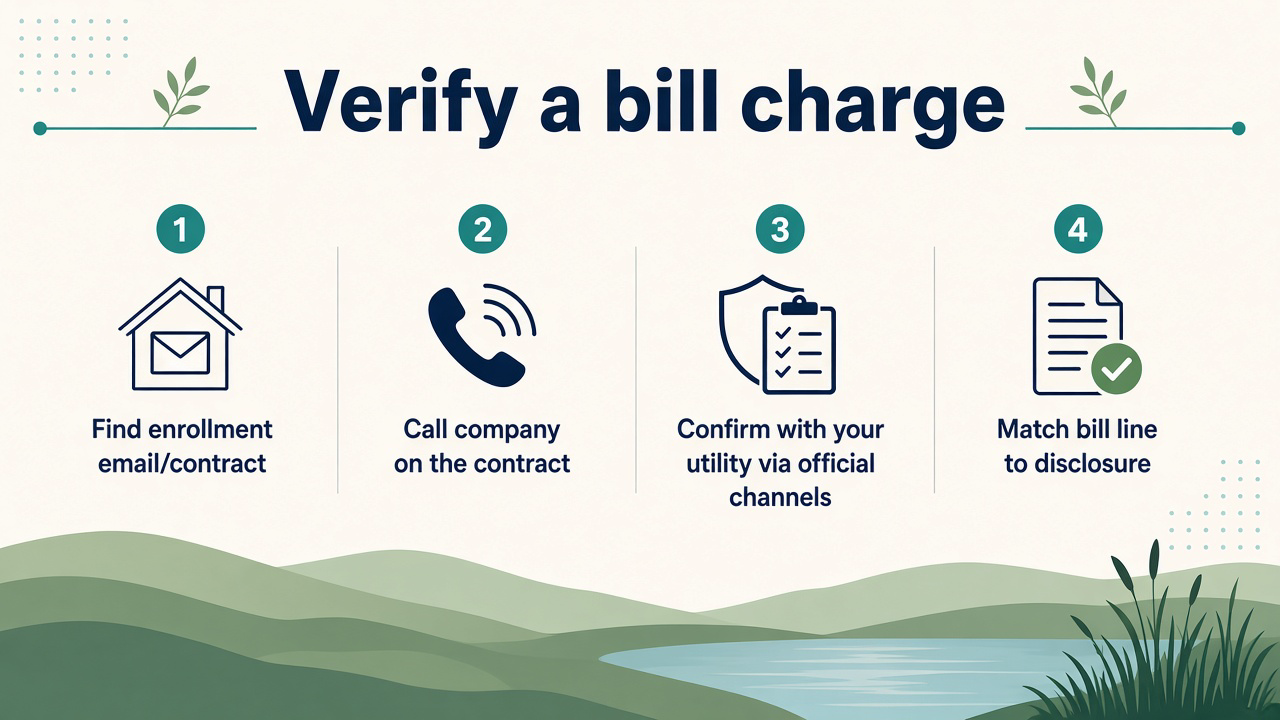
Do not diagnose a stranger’s screenshot. Verify your own account:
- Search email and mail for an enrollment confirmation and a signed agreement.
- Call the company named on the contract (not only a flyer number) and confirm your subscription status.
- Check with BGE through official channels whether a community solar subscription is attached to your account.
- Compare the bill line to the disclosure you signed — credit value, subscription charge, and net effect should match that paperwork.
- If you never signed anything, treat it as urgent: contact BGE and the PSC Consumer Affairs Division, and dispute unauthorized enrollment.
On JoinCommunity.Solar, BGE enrollment that is not self-hosted finishes through a third-party path after you check eligibility with us. We are not BGE. Read the agreement before you sign. Pepco Maryland can also differ from Pepco in D.C. — confirm on the Pepco hub when that is your utility.
How to review a community solar offer
Skip invented star scoreboards. Review the offer like a neighbor who has been burned once:
| Question | What “good” looks like |
|---|---|
| Savings mechanism | Discount on the solar bill credit, spelled out in the agreement |
| Fees | $0 upfront on recommended paths; no “reservation” card before you read terms |
| Cancel / move | Terms in the written agreement (notice period, fees if any, transfer if you move in-territory) — not a doorstep promise |
| Billing | Clarity on one utility bill vs a second invoice |
| LMI terms | How eligibility is verified and what savings floor applies |
| Complaint channel | Company contacts and PSC Consumer Affairs |
Maryland’s PSC rules require many projects to serve at least 40% of output to low- and moderate-income subscribers (unless wholly owned by subscribers). For LMI subscribers, the charge cannot exceed 90% of the bill-credit value — a regulatory floor meant to help ensure about 10% savings on the credit. That is a PSC consumer-protection floor, not JoinCommunity.Solar’s product discount, and not an open-market rate promise. The PSC still does not set your exact commercial rate.
Comparing options? Start with finding the best community solar program for your utility, then verify the live offer for your zip.
How JoinCommunity.Solar handles trust
JoinCommunity.Solar is operated by Our Power Co. (T/A My Utility Advisor), Maryland Public Service Commission Subscription Coordinator No. 23D3065350006676 (also listed on our privacy policy).
How enrollment works on our side:
- One best-matched recommendation for your eligibility — not your contact info sprayed to a dozen callers.
- Paid when enrollment succeeds, not for spam follow-ups.
- A recommendation does not require a Social Security number, bank account, or credit card under our published privacy framing.
- Some utilities enroll on our self-hosted agreement flow; others finish on a third-party path after you start with us. BGE is third-party when enrollment is not self-hosted.
We are not your utility, and we are not Maryland’s only legitimate option. We will not invent a savings percentage here. Discounts depend on utility, farm capacity, and income-qualified status — verify the live offer when you check eligibility.
Maryland protections — and where to complain
Maryland built consumer protections into COMAR 20.62.05. If someone is at your door in Baltimore, Columbia, or Montgomery County:
- No unfair, false, or misleading marketing.
- Door-to-door agents need background checks and training.
- Contract minimums plus a Contract Summary disclosure before you sign.
- Rates are not PSC-regulated — judge the written math yourself.
If something feels wrong after you try the company:
- Keep the contract, disclosure, emails, and bill pages.
- Ask the company for a written response.
- File with the Maryland PSC Consumer Affairs Division through PSC file-a-complaint.
- Prefer the official community solar program page over a viral post.
FAQ
Is community solar legit?
Yes. In Maryland it is a PSC-overseen program with real farms, bill credits, and written consumer protections. Sales pressure is separate from whether the program exists.
Is community solar a scam?
The program is not a scam. Some tactics are abusive. Use contracts, disclosures, licensing, and utility confirmation — not urgency.
How can I tell if a community solar company is real?
Confirm utility territory, get the contract and Contract Summary before signing, verify the company (and license when relevant), and confirm enrollment with your utility.
Why did a community solar line appear on my electric bill?
Legitimate subscriptions can create unfamiliar bill lines. Match them to your agreement and utility account. Never enrolled? Escalate with the utility and PSC Consumer Affairs.
Do I have to pay upfront to join community solar?
Recommended JoinCommunity.Solar paths are designed as $0 to enroll — no installation and no credit card just to get a recommendation. Money demanded to “hold” a seat before you read a contract is a red flag.
Is door-to-door community solar sales allowed?
Only when agents have a criminal background check and proper training. Unfair or misleading claims are still banned. Ask for ID and a contract; you can say no.
Does the PSC regulate community solar rates?
No. The PSC FAQ says it does not regulate community solar rates. Protections cover marketing, contracts, and disclosures — you still need to understand the savings math.
What should I look for in community solar reviews?
Savings math, fees, cancel/move terms, billing clarity, and complaint handling. Ignore fabricated star averages.
Can community solar be canceled?
Yes, subject to your contract. Plan for whatever notice period, fees, and move rules the written agreement states. Do not assume instant cancellation — or a “cancel anytime / no fee” promise — unless that agreement says so.
Is Maryland community solar a real government program?
It is state-authorized under Maryland law and PSC regulations — 2015 pilot, permanent via HB 908, permanent regs published in 2025. Not a federal giveaway.
What’s the difference between community solar and a retail energy scam?
Community solar adds bill credits from shared solar generation. A retail supplier switch changes who supplies your electricity. Do not let a pitch blur those products.
How do I file a complaint about a community solar marketer?
Document everything, try the company in writing, then contact Maryland PSC Consumer Affairs via PSC file-a-complaint.
Next step if you still want to check
You do not have to enroll today. You do have to stop guessing. If your bill is from BGE, Pepco, Delmarva Power, or Potomac Edison, start with your zip, see if a farm has room, read the agreement, and walk away if anything feels off.
Verify with your zip — see a real match before you sign anything →
More reading
JoinCommunity.Solar is operated by Our Power Co. (T/A My Utility Advisor), Maryland Public Service Commission Subscription Coordinator No. 23D3065350006676. We are not your utility, and we are not Maryland’s only legitimate option.
Cancel and move terms live in the written subscriber agreement. The LMI 10% figure above is the PSC consumer-protection floor on the bill credit (subscription charge no more than 90% of credit value), not a product discount on this page. Discounts depend on utility, farm capacity, and income-qualified status — verify the live offer when you check eligibility.